From pilot to progress: Indiana CTSI investment helps advance promising new target in pancreatic cancer research
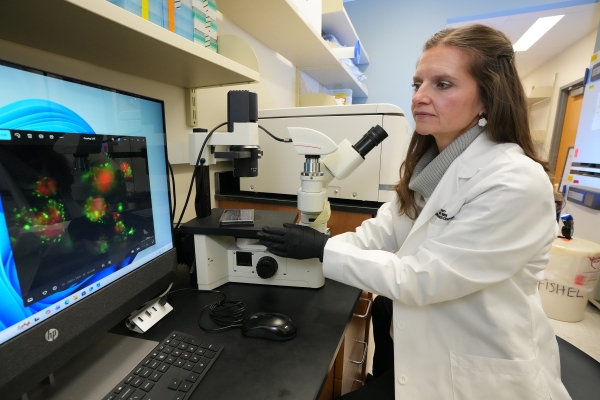
Early-stage support can catalyze long-term impact. The Indiana CTSI played a meaningful role in supporting investigator Melissa Fishel, PhD, at a formative stage of her pancreatic cancer research.
Fishel, an associate professor at the Indiana University School of Medicine and researcher at the IU Simon Comprehensive Cancer Center, recently led a study published in Gastroenterology demonstrating that reducing levels of the clotting protein fibrinogen can shrink primary pancreatic tumors and limit their spread to the liver in preclinical models. This work offers promising insight into how the tumor microenvironment contributes to pancreatic ductal adenocarcinoma (PDAC), an aggressive cancer with limited treatment options. (More details are available in the IU School of Medicine news release.)
“The Indiana CTSI provided critical early support that helped launch this line of research,” Fishel said.
From 2018 to 2021, Fishel received pilot funding from the Indiana CTSI for a project titled “Predictive evaluation of combination therapy involving Ref-1 using state-of-the-art PDAC avatars.” That study explored a different therapeutic strategy, but it enabled Fishel and her team to establish essential capabilities for advancing subsequent lines of inquiry.
“That funding gave us the opportunity to develop PDAC avatar models, generate key preliminary data, and build the foundation for the work that ultimately led to our recent Gastroenterology study showing that fibrinogen depletion reduces primary tumor growth and liver metastasis in pancreatic cancer,” she said.
By investing in innovative approaches and equipping investigators with advanced tools and expertise, the Indiana CTSI helps researchers like Fishel pursue new scientific directions that may ultimately improve outcomes for patients facing pancreatic cancer and other conditions.
